Should you take ChatGPT's £500 ad credit?
 by Harry Watts · · updated · 9 min read
OpenAI has started emailing UK advertisers a match offer: spend £500 on ChatGPT Ads in 14 days, get £500 back in credit. One landed in my inbox, along with a campaign OpenAI had already written for me. I am running the offer now, so my own numbers are a few weeks away, but the draft campaign, and the account it sits in, have already turned up two things worth publishing today. Short answer: take it if a ChatGPT Ads test already made sense for you. The longer answer is that one of the reasons it didn't make sense for local businesses may have just disappeared, and OpenAI's own documentation hasn't caught up.
Platform ad credits are the oldest move in the book. Google has run spend-match offers for new advertisers for two decades. Digiday calls this OpenAI reaching "the coupon stage" of building an ad business, and that is what it is: the platform buying your first test. The same spend-first mechanic runs on all three platforms, with different clocks attached.
When a client forwards me this email, I weigh three things: whether the targeting works for how they sell, whether they can afford the £500, and how they would feel about losing it. Everything below is those three, plus what the account itself showed me.
The offer, exactly as invited
From the invite emails arriving in late August 2026 (terms sit with OpenAI's credit terms and may differ between waves):
- Invitation-only, for advertisers with no prior ad spend in any account related to the business: a new-advertiser offer, not a top-up.
- Accept through the promotional link in the email. Signing up to Ads Manager on your own doesn't enrol you.
- Spend £500 on qualifying campaigns within 14 days of accepting. The 14 days matches the US wave Digiday documented; OpenAI publishes no window for the GBP offer, so read your own email rather than this article for the date that binds you.
- Receive one £500 credit for future eligible spend, one per customer or business, one account.
- The credit expires 90 days after it's issued, spent or not.
Net effect: £1,000 of delivery for £500 cash, but structured as two phases, not a discount at the till. You fund the first £500 in full and at pace (£36 a day for a fortnight), and the matched £500 arrives afterwards with its own clock running.
The campaign OpenAI wrote for me
The line in the email that deserves more attention than the money: "we've already created your first campaign draft." Open Ads Manager and there it is, generated from whatever OpenAI could infer about the business. Here is mine, untouched.
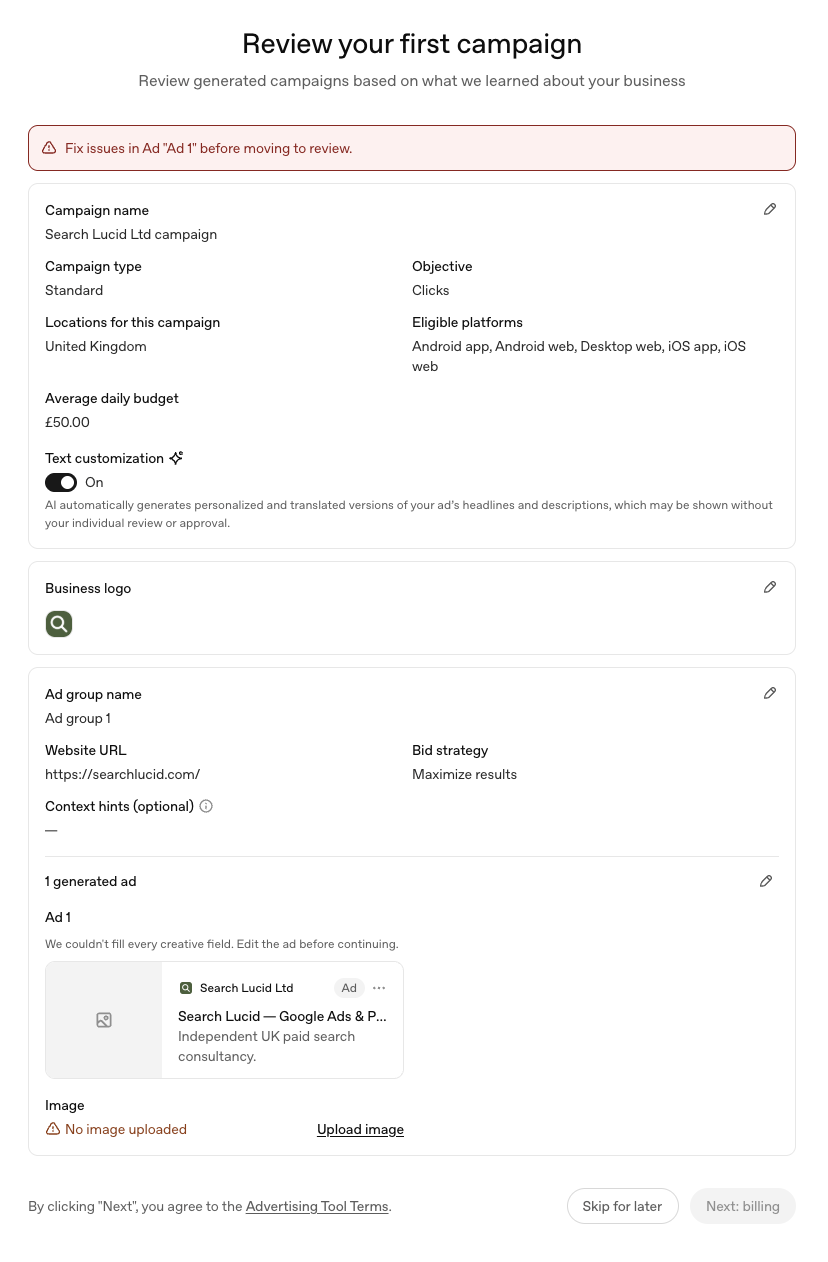
An earlier version of this article called that a reasonable guess. Looking at it properly, it isn't one. It is an unfinished campaign that still offers a Next: billing button. Red banner at the top, an ad that "couldn't fill every creative field", a headline cut off mid-word, no image. What it did fill in confidently is the half that costs money:
- £50 a day. Across a 14-day qualifying window that is £700, about 40% more than the £500 the offer asks for. The offer's own pace is £36 a day.
- Objective: Clicks. Bid strategy: Maximize results. ChatGPT Ads offers a conversion-optimised objective; the draft didn't pick it. Clicks optimises for the thing I pay for rather than the thing I want.
- The landing page is my homepage, the front door, which is the default every advertiser should argue with and almost nobody does.
- Context hints: empty. On this platform that field is the targeting. Blank means nothing is narrowing who sees the ad.
- Text customisation: on. OpenAI's own wording on the screen: AI-generated versions of your headlines and descriptions "may be shown without your individual review or approval". If your positioning is the product, that is the first setting to find.
- Five placements, app and web, iOS and Android, all on by default.
So the lesson isn't the usual one about checking the machine's work. It is that the machine stopped short of finishing the ad and did not stop short of setting the budget. Everything it left undone was creative; everything it completed was spend.
Targeting: my account was six days ahead of the documentation
When this went up, every published source said the same thing. OpenAI's help centre, then updated 5 September 2026: "Ads Manager Beta supports campaign-level country targeting and, in the United States, supported state, designated market area (DMA), and ZIP code targeting." The geotargets file OpenAI publishes for advertisers carried five UK rows: the country, plus England, Northern Ireland, Scotland and Wales. Nothing below. PPC Land reported the geo-targeting launch in May as US-only, and two independent analyses in August, one of them from a direct pull of that same file, concluded the same.
On 6 September 2026 I typed a Leeds postcode district into the location picker in my own UK account. It took it. So did a London one.

Be careful what you take from that. The picker accepts the districts and the interface states that the campaign "will only show in selected locations", but nothing of mine has run through them yet, so I can't tell you delivery honours it. That is now part of what I am testing. Note too that in the shot above, United Kingdom is still selected alongside both districts, which targets the whole country regardless; if you try this, remove the country first or the districts do nothing.
On 12 September the documentation caught up. The same help page now answers the question directly in its own FAQ: "Can I target a state, city, DMA, or postal code?" Yes, it says, for "states or regions, cities, DMAs, and postal codes where available", with availability varying by country. The sentence quoted at the top of this section is still sitting above it, unchanged, still naming only the United States, so the page now disagrees with itself and the FAQ is the newer half.
What has not changed is the instruction that made the picker worth trusting before there was anything official to point at: "Search for a location in the campaign location picker to confirm whether it is currently supported." If you sell locally, spend the thirty seconds and check yours before you accept a word of this, including from me.
The three things I actually weigh
One gate before them: excluded categories (healthcare, financial services, legal, gambling) can't advertise at any price, and a credit doesn't reopen a policy. For everyone else:
- Does the targeting fit how you sell? Until early September the answer for a Leeds plumber was a flat no, and this article said so. Now it is: open the picker and look. If it offers you nothing under United Kingdom and you sell within twenty miles, the credit changes nothing worth having: cheaper waste is still waste.
- Can you afford the £500? At the offer's pace that is £36 a day for a fortnight, or £50 if you leave the draft's budget where OpenAI put it. If that pace is uncomfortable, the deadline is working on you rather than for you.
- How would you feel about losing it? This is the one that decides it, and it is the one the offer's framing hides.
The £500 at risk is yours. OpenAI's Ad Credit Terms are explicit that eligible fees are only those incurred after a credit has been issued, so the qualifying spend is never recoverable: you cannot earn the credit back with the credit. If the credit doesn't issue, because the window closed or eligibility gets judged after the fact, you have spent £500 on a platform that still has no published benchmarks and kept whatever you learned. That is a defensible thing to buy. It is a bad thing to buy by accident because the email said the word free.
If you accept, run it like it's your money — because half of it is
- Wire measurement before the first pound. Pixel and Conversions API, deduplicated. £1,000 of unmeasured delivery teaches you nothing: the tracking discipline is identical to Google's.
- Rebuild the draft rather than editing it. Budget, objective, landing page, context hints and text customisation are five decisions the generator made for you, and correcting them one at a time is how one gets left behind.
- Plan both phases now. Phase one: your £500 over 14 days. Phase two: the credited £500 across the following weeks, with a decision point at roughly day 60 of the credit window, judged on cost per customer against your target, not clicks.
- Write down what "carry on" would require before you start. A number agreed with yourself in advance is the only defence against a platform's sunk-cost gravity.
What the coupon stage tells you
Platforms buy testers when they need benchmark data and case studies more than they need margin. It's what Google did in 2005 and what every ad network does at this point on the curve. Two things follow: OpenAI is pushing hard from beta toward a real revenue line, and enough advertisers are hesitant that it is paying for conviction. Neither is a reason to rush. Both are reasons the next six months will look unlike the last three, and the targeting picker above is the first evidence of it: the product is moving faster than the pages describing it.
Quick answers
How does the £500 credit work?
Accept via the promotional link, spend £500 on qualifying campaigns in 14 days, receive £500 credit for future spend. One per business; the credit expires 90 days after issue.
Who qualifies?
Invited advertisers with no prior spend in any related account: a new-advertiser offer. The terms here are from the UK invite wave of late August 2026; OpenAI's credit terms govern.
Is it worth taking?
If a test already made sense for you, yes: it halves the cost of finding out. Check three things first: that your category is permitted, that the location picker offers targeting you can use, and that losing the qualifying £500 would be survivable rather than painful.
Should I launch the pre-built campaign?
Not unread. The one OpenAI built for me arrived with an unfinished ad and a £50 daily budget, 40% above the pace the offer required. Check the budget, the objective, the landing page, the context hints and the text customisation setting before anything goes live.
What happens when the credit expires?
It lapses at 90 days, spent or not. Judge the test at about day 60 on cost per customer; continue on evidence or stop with cheap, conclusive learning.
Got the email and not sure whether it's for you
A free intro call settles it in thirty minutes: whether your category and your targeting fit, what phase one should look like, and what number would justify phase two. I run ChatGPT Ads on its own or alongside Google and Microsoft, and adding it to either doesn't double the fee.